

AC Basic Terms: Peak, RMS and Average Value
By Er. Rohit Ghimire 31 Mar 2026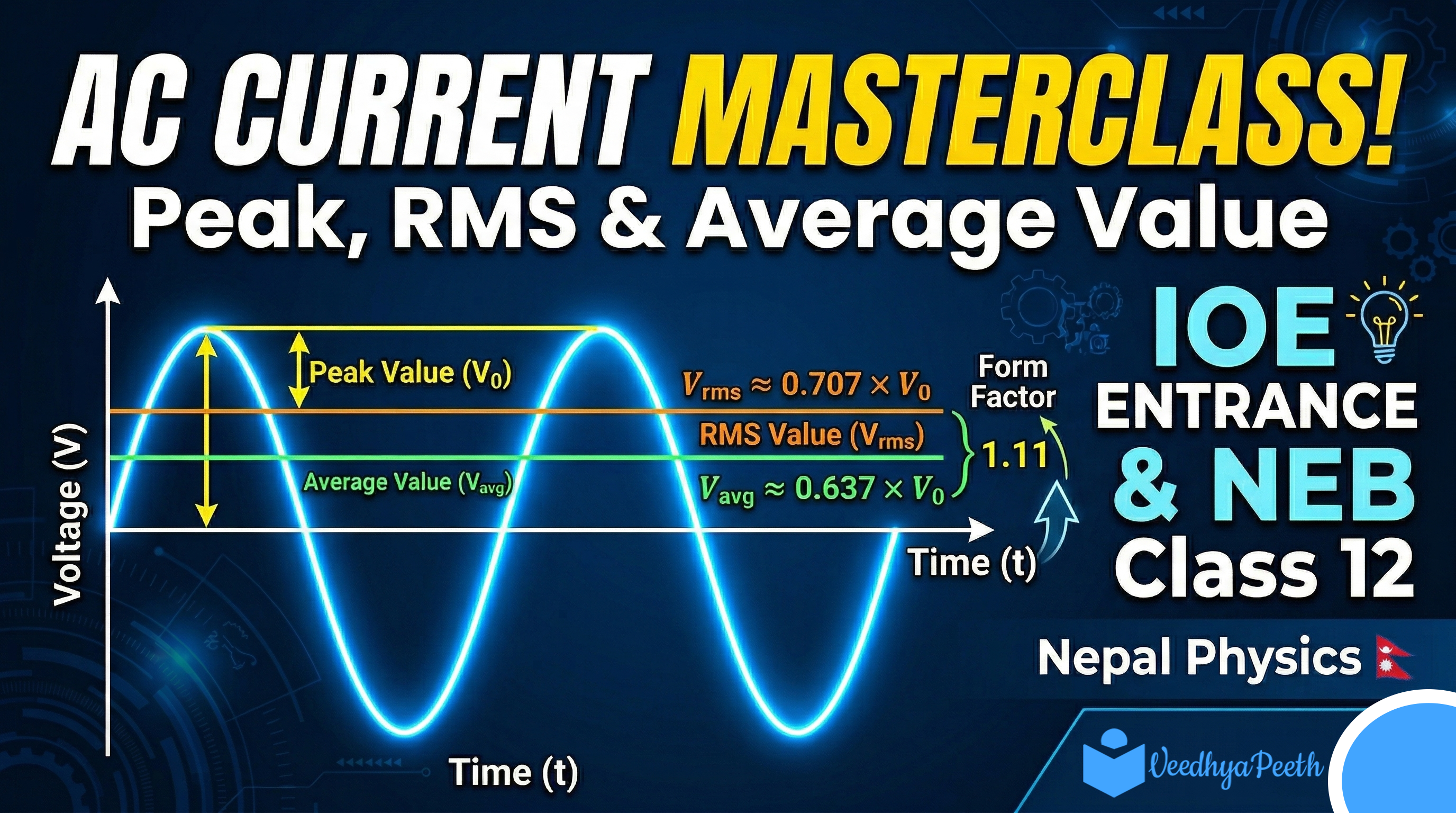
Basic Terms in Alternating Current — Peak Value, RMS Value & Average Value | NEB Grade 12 & IOE Entrance
Alternating Current (AC) is one of the most important chapters in NEB Grade 12 Physics — and it is tested heavily in every IOE and KUCAT entrance exam in Nepal. Before you can solve any AC circuit problem, you must understand the basic terms that describe an alternating quantity. This article covers Peak Value, Average Value, RMS Value, Form Factor, Impedance, and Admittance — the foundation of everything in this chapter.
IOE past papers consistently include 2–3 questions from this section alone. Master these terms and their formulas and you are already ahead of most students.
What is Alternating Current?
An alternating current is an electric current that periodically reverses direction, unlike direct current (DC) which flows in only one direction. The instantaneous values of AC voltage and current vary sinusoidally with time.
The instantaneous AC voltage and current are given by:
- V(t) = V₀ sin ωt — where V₀ is the peak voltage
- I(t) = I₀ sin ωt — where I₀ is the peak current
Here ω = 2πf is the angular frequency and f is the frequency of the AC supply.
Watch: Basic Terms in Alternating Current (Free Lesson)
In this video, a Pulchowk Campus engineer explains all basic AC terms with clear diagrams and examples, specifically tailored for NEB Grade 12 and IOE Entrance preparation.
1. Peak Value
The peak value (also called the maximum value or amplitude) of an alternating quantity is the maximum value it reaches during a cycle — either positive or negative.
- Peak voltage = V₀
- Peak current = I₀
In Nepal's household AC supply, the peak voltage is approximately 220√2 ≈ 311 V. The 220V you see written on appliances is the RMS value, not the peak value — this distinction is extremely common in IOE MCQs.
2. Average Value
The average value of AC over one complete cycle is zero — because the positive and negative half cycles cancel each other out. Therefore, average value is always calculated over a half cycle.
Mathematically:
- Average voltage: V_avg = 2V₀/π ≈ 0.637 V₀
- Average current: I_avg = 2I₀/π ≈ 0.637 I₀
Important for IOE: When a question says "average value" without specifying, it always means the average over a half cycle.
3. RMS Value (Root Mean Square Value)
The RMS value is the most important term in AC. It is the equivalent DC value that would produce the same heating effect (power dissipation) in a resistor as the AC quantity. This is why your household voltmeter reads 220V — it is measuring the RMS voltage.
Mathematically:
- RMS voltage: V_rms = V₀/√2 ≈ 0.707 V₀
- RMS current: I_rms = I₀/√2 ≈ 0.707 I₀
Why RMS and not average?
AC ammeters and voltmeters are designed to measure RMS values — not average values. Hot wire instruments work on the heating effect of current, which depends on I² (square of current), so they naturally measure RMS. A moving coil ammeter cannot measure AC because the average value of AC over a full cycle is zero.
Nepal household supply: The mains voltage of 220V in Nepal is the RMS value. The actual peak voltage = 220 × √2 = 311V.


4. Form Factor
The form factor is the ratio of RMS value to the average value of an alternating quantity.
- Form Factor = V_rms / V_avg = (V₀/√2) / (2V₀/π) = π/(2√2) ≈ 1.11
For a sinusoidal AC, the form factor is always approximately 1.11. This value appears directly in IOE MCQs.
5. Impedance (Z)
Impedance is the total opposition offered by an AC circuit to the flow of alternating current. It is the AC equivalent of resistance in DC circuits.
- Symbol: Z
- Unit: Ohm (Ω)
- Formula: Z = V/I = V_rms / I_rms
Impedance includes both resistance (R) and reactance (inductive or capacitive). In a purely resistive circuit, Z = R. In circuits with inductors or capacitors, Z depends on frequency.
6. Admittance (Y)
Admittance is the reciprocal of impedance — it measures how easily AC flows through a circuit.
- Formula: Y = 1/Z
- Unit: Siemens (S) — same unit as conductance
7. AC Circuit Combinations — Impedance & Phase Difference
Once you know impedance and reactance, you need to apply them to the five standard AC circuit types. These combinations are tested directly in IOE, KUCAT, and NEB Grade 12 exams — memorize the impedance formula and phase angle for each.
| Circuit Type | Impedance (Z) | Phase Difference (Φ) & Power Factor |
|---|---|---|
| Pure Inductive | Z = XL = ωL | Φ = π/2 (90°); Power Factor = 0 Current lags voltage by 90° |
| Pure Capacitive | Z = XC = 1/(ωC) | Φ = −π/2 (−90°); Power Factor = 0 Current leads voltage by 90° |
| R-C Circuit | Z = √(R² + XC²) | tan Φ = −1/(ωCR); cos Φ = R/Z Current leads voltage |
| L-R Circuit | Z = √(R² + XL²) | tan Φ = ωL/R; cos Φ = R/Z Current lags voltage |
| L-C-R Circuit | Z = √(R² + (XC − XL)²) | tan Φ = (XC − XL) / R Depends on whether XC > XL or XL > XC |
Key Points for IOE Exams
- Pure inductive and pure capacitive circuits: Power Factor = 0 — zero average power consumed. This is a direct MCQ answer.
- Purely resistive circuit: Φ = 0, Power Factor = 1 — maximum power consumed.
- CIVIL mnemonic: In a Capacitor, I leads V. In an Inductor, V leads I.
- At resonance in L-C-R: XL = XC, so Z = R (minimum), Power Factor = 1, current is maximum.
- Power Factor = cos Φ = R/Z for all R-C, L-R, and L-C-R combinations.
Reactance Formulas
- Inductive Reactance: XL = ωL = 2πfL (Unit: Ω) — increases with frequency
- Capacitive Reactance: XC = 1/(ωC) = 1/(2πfC) (Unit: Ω) — decreases with frequency
XL increases with frequency (inductors block high-frequency AC). XC decreases with frequency (capacitors block DC but pass high-frequency AC). This frequency behaviour is a common NEB short answer question.
Quick Reference — All Formulas
| Term | Formula | Approximate Value |
|---|---|---|
| Instantaneous Voltage | V(t) = V₀ sin ωt | — |
| Average Value (half cycle) | V_avg = 2V₀/π | ≈ 0.637 V₀ |
| RMS Value | V_rms = V₀/√2 | ≈ 0.707 V₀ |
| Form Factor | V_rms / V_avg = π/(2√2) | ≈ 1.11 |
| Impedance | Z = V_rms / I_rms | Unit: Ohm (Ω) |
| Admittance | Y = 1/Z | Unit: Siemens (S) |
Solved Example
Q: The peak voltage of an AC supply is 311V.
Find (i) RMS voltage (ii) Average voltage.
Solution:
(i) V_rms = V₀/√2 = 311/√2 = 311/1.414 = 220V
(ii) V_avg = 2V₀/π = 2 × 311/3.14 = 198V
Notice: 220V is Nepal's standard household supply — this confirms that our mains voltage is the RMS value of AC with peak value 311V.
Test Yourself — 10 MCQs on Basic Terms in AC
Try each question before reading the solution. These are IOE-pattern questions.
The RMS value of an AC current with peak value 10A is:
The average value of AC over one complete cycle is:
The mains supply voltage of 220V in Nepal represents:
The form factor for a sinusoidal AC is approximately:
Why is a moving coil ammeter not used to measure AC?
If peak voltage is 220√2 V, the RMS voltage is:
The unit of admittance is:
The ratio V_rms / V_avg for sinusoidal AC is:
Hot wire instrument measures which value of AC?
The impedance of a purely resistive AC circuit of resistance 10Ω is:
Exam Sample For IOE Entrance Preparation
Try each question before reading the solution. These are IOE-pattern questions and your real knowledge test.
The equation of an AC voltage is V = 100√2 sin ωt volt. Find its root mean square voltage
Alternating current/e.m.f. measuring instrument measures its
40Ω electric heater is connected to a 200 V , 50 Hz main supply. The peak value of electric current following in the circuit is approximately
Conclusion
Understanding Peak Value, RMS Value, Average Value, Form Factor, Impedance, and Admittance is the foundation of the entire Alternating Current chapter. These terms appear in almost every IOE and NEB exam — get them right and you've already secured easy marks.
Want full MCQ solutions + more practice questions sets?
Join Veedhyapeeth — Nepal's IOE & KUCAT preparation Course Designed by Pulchowk engineers.
FAQs
In a complete cycle, the alternating current flows in the positive direction for the first half and the negative direction for the second half. Since the areas under the positive and negative curves are identical, they cancel each other out mathematically, resulting in a net average of zero.